
How to Beat the Rich Drivers and their Staff

Welcome to a free edition of Terence Dove on Racing Drivers. You get a free episode every month. Upgrade for the full weekly edition, you won’t regret it!
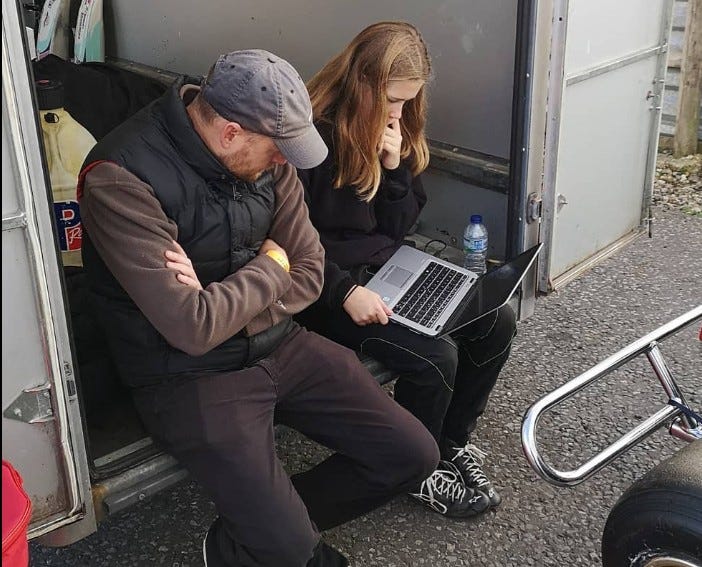
At a big kart meeting you will be up against some professional outfits. Let’s call them the big dogs… the teams who attract rich customers and who dominate the engine supply and expertise.
Their staff are ex-world champions, national champions themselves, and they have won titles like that as a team so many times they don’t bother counting.
That’s who you are racing against, more so than the drivers - you are fighting the central command structure behind the whole operation.
The driver might be a rich kid, trained hard with a million laps to be as much a solid driver as can be managed. The purpose is that the set ups and tyre pressures, combined with a top selected engine can do its bit with as little restricting as possible from the driver. The team isn’t looking for more from a driver, but less in terms of mistakes and interference, so the kit and expertise can do the winning.
Inside the tent there are staff doing stuff for the drivers, more than ‘with’ the drivers. Decisions are getting made with a bit of feedback from the driver, but mostly made independently by staff using the data and with a super experienced team watching the kart itself like a hawk.
They want the driver to cover driver hygiene and they can handle tyre pressures, refined set up changes, jetting etc.
That’s what they are paid to do, and paid a lot. And naturally everybody looks good when it works which it usually does.
...
What is the Achilles Heel of these very strong karting operations?
When you have a driver with lots of staff they tend to let their staff do what they are paid to do, while the driver does sweet FA or finds something less taxing and performative... Playing catch with a PT for example.
This separation of kart and the deep refinement process of finding speed from the driver is the weakness.
(Incidentally, this is something the FIA is trying to grow with their academy programs, they just want drivers as pilots, alien to the actual kart development entirely)
This separation is growing and becoming the norm, and it’s to your advantage as someone who does everything they can for themselves..
A real racing driver has an intimate relationship with their kart. It is THEIR kart.
They also have a deep relationship with their own driving, especially through data and video. Whereas data is something you look at and pretend interest when in a big team, and your own driving improvement is spoon-fed to you by someone like me!
If you can deepen your relationship with your kart to what should be like a love affair, and your relationship to your own data to an obsession, you can beat the teams...
This is because the depth and synergy of a driver and kart working in harmony and deeply obsessed with their own data, cannot be matched by a driver who just drives with a separate staff running the kart and data.
Why?
If you are responsible for, and physically running your kart yourself, then you are making the bet that your idea will work. You will get emotionally driven to make the kart work with your settings.
OR… if you aren’t trying to prove a setting and running a pure experiment, you will be alive to the changes you just made and ready to feel, I mean literally feel, the difference.
You are the one in the seat asking, does this thing feel better with what I just did to it. You are asking and feeling for the answers live. You are searching every corner for where it tells you about the kart, and that triggers hyper focus
Compare that to a standard team scenario. Someone, not the driver, changes something on the kart. After the run they ask the driver how was the kart with that setting.
The response from the driver is: Ok and a shrug.
The driver looks at the timing for where they sit in the order, and they don’t care about the kart so long as it’s ok. The staff can look after all that stuff!
Data - Brain and data integration VS being told
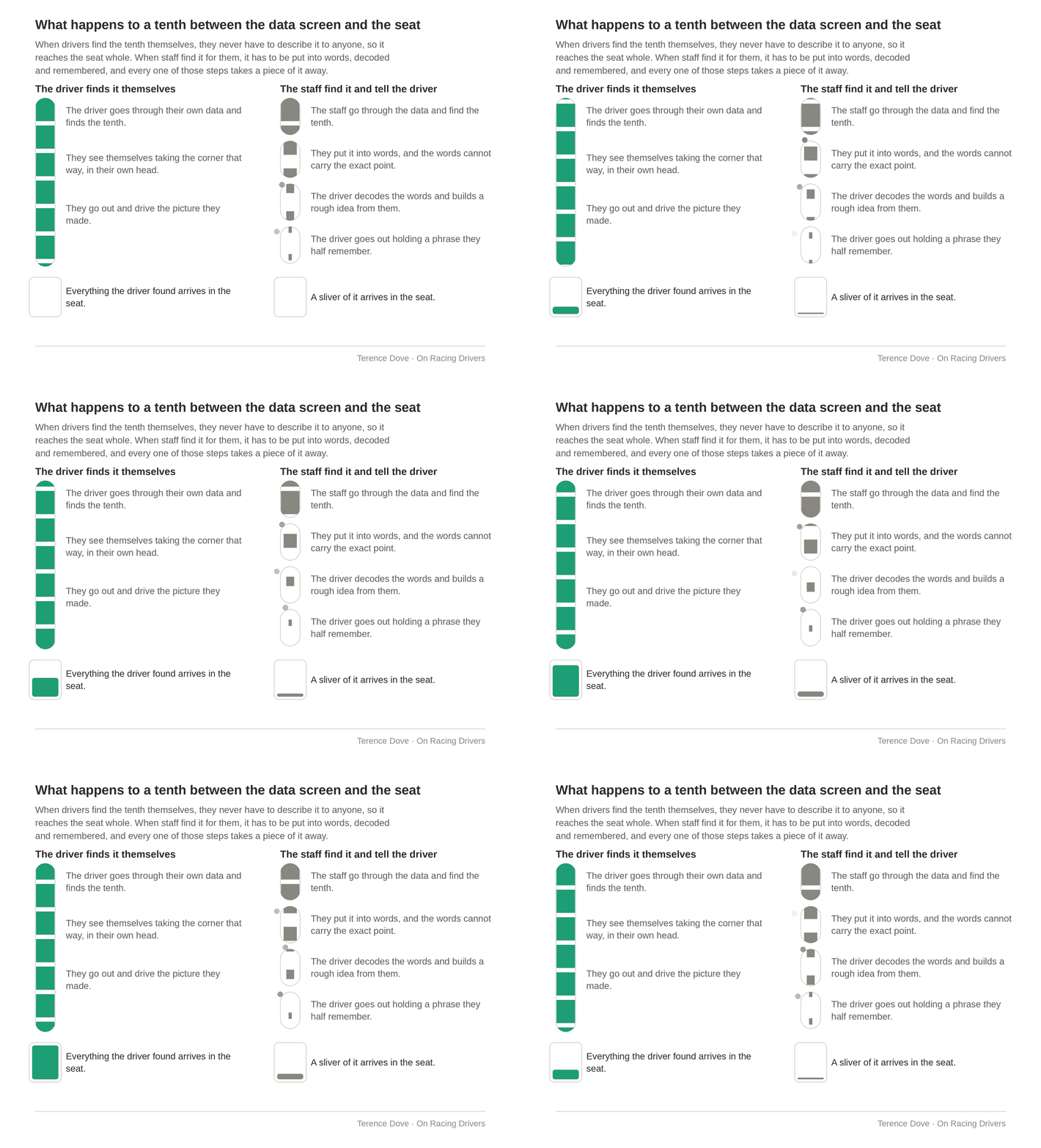
No matter how good someone like me is with drivers, your own curiosity is far superior to having someone deliver information to you.
I can look deep into data with a driver and help them find time, but it’s still being imposed on them so the channel of communication is always restricted at some point.
When you are scouring data like an obsessed freak, and you find something yourself, then set about replicating it in your own imagination, a driver/coach combination can’t get anywhere near that for quality.
That’s real visualisation, when you generate in your mind how you will drive a corner to replicate a tenth you found in the data. That happens totally naturally, you just do it when you are trying to ‘see’ what happened when interpreting data, and generating an internal playback of how to repeat it. .
Anyway, the important point is that when you have naturally been recreating or even inventing ways to produce the cornering that data tells you was actually quicker, you carry that onto the track yourself... A seamless transition from the data screen into real world actions all held in your mind.
How much better is that than some bloke telling a driver that’s what they have to do, in words that can’t quite get the point exact, and that the driver will forget anyway?
Data Immersion tips for the lone wolf driver
Don’t just compare fastest laps
Comparing fastest laps is a very good idea. It is very motivating. But when you need to go deep, you should compare like for like laps. You should be looking at all laps where performance counts.
For example, are you looking at how fast you drove after the tyre goes off. You should be bringing up lap8 in run 1 vs lap 8 in run 2 and looking for where you nailed it, then seek to repeat that and eliminate the slower way.
Early laps are super important. Don’t just say ‘oh the tyres aren’t up to temp yet’ and ignore them. Compare lap 2 vs lap 2 in the next run and pull it to pieces. Seek to hit perfect lap 2 performance.
Be curious - How the hell did I do that?
Pull up every lap in a run and search out little hot spots. Then imagine how you did it.
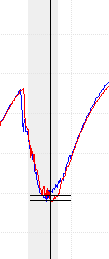
The blue line on a random lap picks up out of the hairpin, it’s clearly better than the red line which I did on the fastest lap.
“I have to figure out how the hell I did that because I don’t remember screwing that corner on my fastest lap!”
When you stare at that long enough as the driver who actually did both, you will be able to imagine what happened on both laps. Here, the red line is a lap where the engine dies a bit on the exit of a hairpin. The blue shows a clean pick up.
You know what that sounds like and you know what that feels like. You will hunger to repeat that blue line exit!
Try to beat fast-in vs fast-out
In the data you will often see where you got a bit of time on the way into a corner only to lose the same on the way out. It balances out perfectly.
But, that doesn’t mean you should let it go. What if you can make the fast-in part of the corner work, and preserve the exit speed all the same. Can you do fast-in and fast-out.
Where you see that balancing happen in the data, try to defy the equation and best it. Run through your mind where you remember how fast-in cost you time.
Did you go outside the ideal line?
Did you lose the rear and get a bog?
Maybe the kart got a bit of a bounce on
Did you fail to get off the brake nicely enough to maintain stability?
Each of those scenarios gives you a chance to imagine how you can predict, and mitigate those likelihoods whilst maintaining that entry speed. You have a good chance of nicking a tenth on entry and maintaining it.
Thanks for reading
Terence