
Karting Data is About Targets - Not Objective Facts

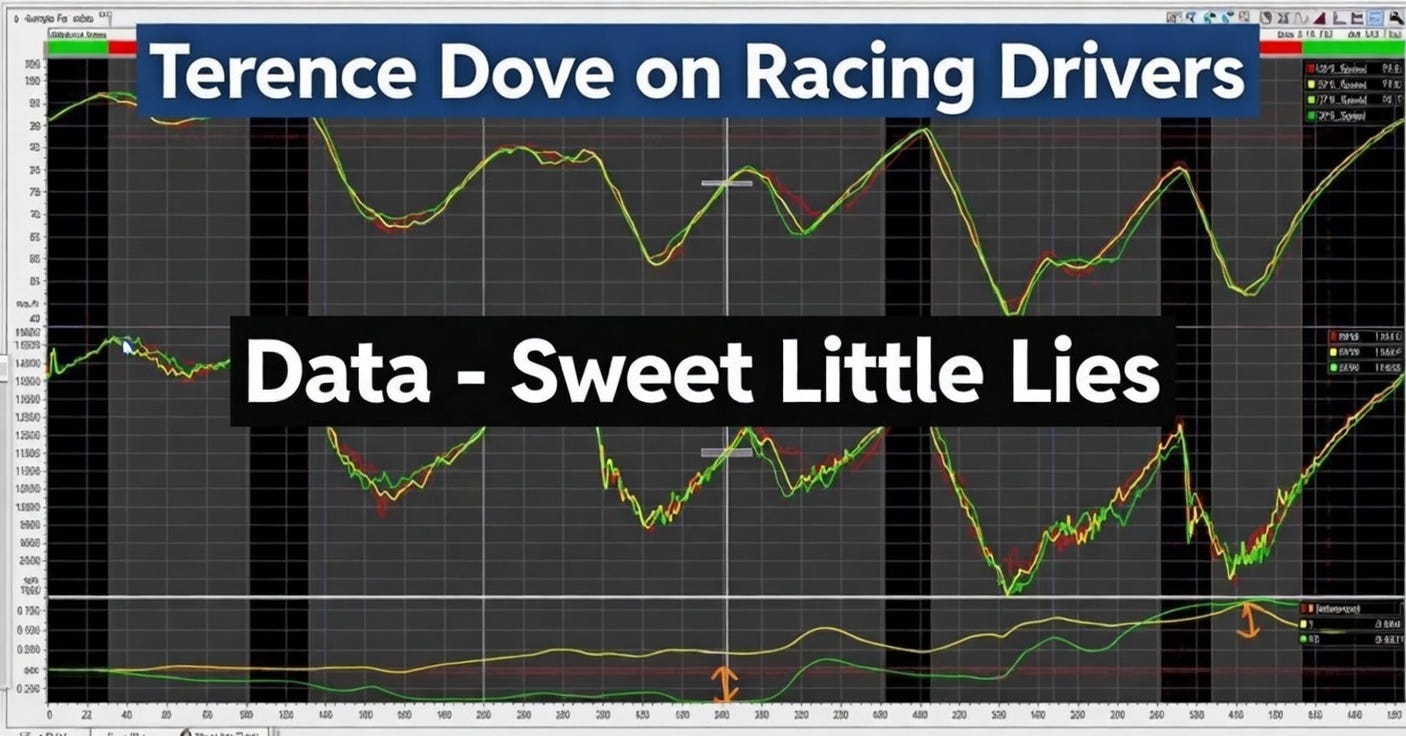
Don’t forget the audio is not just a read through, in fact this week’s audio I think is better than what I have written - so give it a listen!
Has the novelty of data systems on karts disappeared? Are they boring now that everyone has one?
A data system used to feel like a real advantage, and drivers would be all over the screen in wonder. The attitude was ‘this is pure gold and nobody else has it!’.
Now when the laptop comes out the standard reaction is:
“Oh here we go, you’re gunna have a go at my driving now”
Data has become like the obligatory track walk - something that you just do. And just like anything else that is just something you do, nobody gives a damn. The morning track walk is done with a coffee and by rote, and data is done as a box to tick.
Indicators that data lost its shine
The driver has to be shown the data.
The driver doesn’t rush back to the van to download their own data and disappear with the laptop.
The driver doesn’t point at the laptop screen declaring ‘holy shit!’ because a new 2 tenths jumped out of the screen at them
Of course I’m being a bit sarky here, because I know nobody is looking at their data that way.
Why, because it has become clinical and stripped of meaning and therefore power. It doesn’t engage the racer’s brain any longer - quite the opposite!!
So, a device that can tell every single driver how to go faster sits there redundant, whilst everyone prefers to scratch their heads and pretend that there isn’t much left to do.
How to reignite data passion and get back on it.
Here are 3 golden rules to get yourself back on the data so that every session is full of drive, purpose and deep focus - IF you have been neglecting it.
Data is for setting targets you know are achievable, and are based on what you can actually do.
Data should be used to give you a lift, a goal, in support of the possibility you can in fact hit those lap times.
Targets from data are far more important than objective facts!
The third rule there is the one that will raise eyebrows, because it says let the data tell you lies if it helps you drive faster.
Data is a wonderful artist for painting goals that objectively speaking aren’t bulletproof. BUT goals convincing enough that they give us the ‘feels’ necessary to actually hunt them down and find the time.
The connection with the data must make you hope, must give you positive goals and must make you look forward to getting on the track and delivering on what is promised.
All racing is based on optimism despite a lot of facts, that’s why it is a pursuit for the brave and crazy. So data just needs to tell a good enough story to do what is needed.
That’s a lot different to looking at the data with someone who wants to prove you are full of shit, or just in a performative manner to prove you are doing what you should.
Example data tricks I use to get drivers fired up
In a nutshell, anything I can find that is verifiable and convincing enough to prove that a driver has already driven a part of the track fast enough, to make their fastest lap even quicker.
Drivers look at the fastest driver in a session, or whatever benchmark they have and feel like they need something to bolt on the kart to find that time. Faster engine, better tyres, magic set-up.
That’s a very hard mindset to crack. Plenty of people around the paddock will say no, you are driving crap - but that doesn’t do much except depress them.
I use the data to show them the time is there, they have already driven fast enough on particular corners to get that time - it just needs to happen all on the same lap.
In other words YOU have the speed, YOU have the kit and you just need to put this together. you have already done it, you ARE fast enough.
1. Time difference lines - identify gains, add them up
Using the time difference or delta chart is the most reliable way to find where you are faster than you think. All the dashes have this in the software.
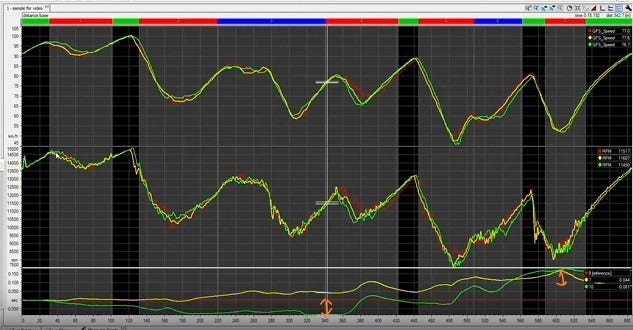
The delta chart shows time gains explained here and those little orange lines I drew on show a one tenth absolute gain, and a speculative tenth. So, I can speculate with reasonable confidence that the fastest lap should have been 2 tenths faster, and absolute confidence one tenth.
When you say to a driver one tenth, maybe two - the word ‘one’ is deleted, they accept two tenths. In their mind they did that lap time.
You have to reverse engineer how those gains were made - so long as those ideas are feasible a driver feels the possibilities and very often delivers.
Now, gps is kinda sketchy on how those deltas are created - if you go deep into it like I do you might find some anomalies let’s say. Don’t bother! My experience is that drivers go faster when they focus on finding time they believe is there. So believe and go faster (what a book title!)
Theoretical best - run with it!
This is a bit more sketchy than the delta chart, but when your faith has been rocked get on the theoretical table! It’s not fabricating anything and it does its best to show where you aced a split. Use my rule of thumb and you will be within reason.
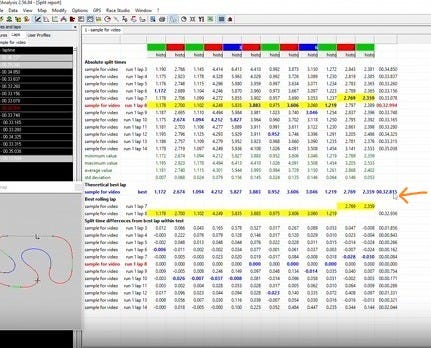
Theoretical best adds all your fastest splits together, and says what your fastest lap would be if it was all the fastest splits only. With the MyChron software it divides every corner so you get a lot of splits and it produces a very optimistic time.
Now we all know you can cheat that easily by going way too fast into a corner, and fluffing the exit. The theoretical best will include that.
BUT do you often do that? Not really…
Who cares anyway, look at the number. As a driver, your instinct will see that number and want to see it on your dash during the next run, because you know that number is constituted of your driving and nothing else.
Rule of thumb. Theoretical plus 2 tenths is a sensible target. More accurate updates of Race studio 3 may even give a sensible target.
Summary
If you have let the data slip, or it has become a performative meaningless exercise then it’s useless.
You need to use the data as a way to feed your positivity and your imagination. If you see that there’s a tenth or two going begging - you have to recreate in your mind how you did it (just not on your fastest lap).
People go nuts about visualising, but this is real use of mental imagery to find real time rather than a party trick.
So, get back on the data, use it to find positivity and specific parts of the track to focus on - whether or not it’s accurate isn’t really the thing. It gets you thinking and it gets you focussed, whilst everyone else is messing around.
Thanks for reading
Terence
So you don't even get laptimes? I guess you either need a magnetic pickup or an optical one. Or one of those human things who has to watch you and press a button every time you drive by, I used to have one of those 😂
My mychron is currently acting as steering wheel ballast 🤣. GPS is all over the place (spoofing) it has no clue where it is. Thanks Donald 🙄