
Karting is the Ultimate Man and Machine Experience
Get intimate with your kart, tweak it and become greater as a driver.

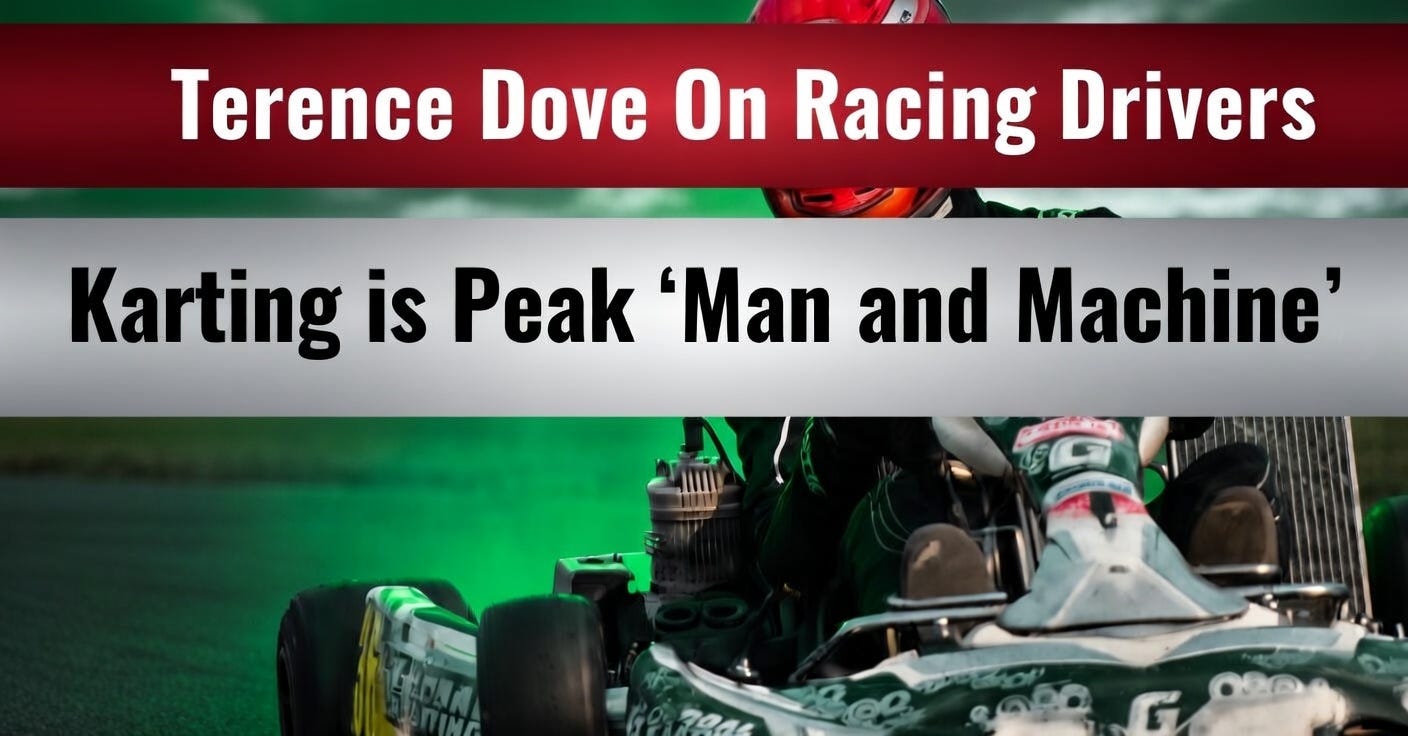
Your kart, how it drives, looks and feels should be a magnificent expression of what it means to be a pure racing creature.
The way you tune a kart to speak for you when you drive creates nothing less than a work of art, great art. When you bring a kart closer to what you want from it, by tuning it, the more clear and frankly beautiful, that expression and art becomes.
The more you discover independently the better. To that end you are better to ignore all advice, especially if it’s good!
BUT this does depend on you becoming deeply engaged with your kart.
Compared to when I raced you are up against serious barriers to creating that kind of kart and driver symbiosis. The attempts to make karting fit various agendas about fairness and convenience are trying to take karting in a direction that adds weight and deliberately separates the kart from the driver.
So you have my sympathy. There’s a lot of crap added to karts that is against the principle of the kart - and they are adding weight and complexity all the time, making it so hard to run one without paying staff and running in a team situation.
This means the temptation to leave the mechanic to it, and ignore the kart like everyone else is irresistible really. If you want to turn yourself into a half driver, that’s fine.
If however, you have the drive to make of yourself a great driver, then you need to step-up and get stuck into working on your kart with real commitment.
The job of the racing kart is to connect the driver to the road with the fewest barriers possible. It is the simplest, lightest and most perfect way to drive and race.
This is what makes it peak driving, and the pinnacle of motor racing. F1 can’t touch it in that regard!
Point is, YOU as a kart driver are really, truly at the top of the racing pile.
And in accordance with your art, for which we all suffer, you should be maximising your relationship with the kart and tuning it to perfection, because tuning a racing kart is tuning the ultimate racing machine. It’s peak driving and peak man and machine harmony - what more can you want?
And by perfection, I mean perfection between you and the kart reached by you, not someone else’s idea of a good set-up.
Before we get into kart tuning - a couple of boxes need ticking
Fitness - If your physical limit is below that of the kart, then you won’t be in any position to feel your kart and properly dance with it.
The kart needs love - You have to get really familiar with all of the kart. This is one advantage a kart has over all other vehicles. It’s possible at almost any level of experience to strip one down and rebuild it. When you put a kart together, every part of the kart is yours.
And by the way, even if you do indeed love your kart, when you race you have to be utterly disinterested in its survival! It’s a bit weird but your kart is something you should cherish and not give a damn about at the same time.
What you gain in the swings you lose on the roundabouts
Everything on a kart tends to be a compensated change. That means add a tooth, you gain acceleration and lose top speed. Increase tyre pressure and the tyre performs earlier in a run, and gives up earlier.
So many changes make no real difference to your lap time. Even when you make lap time gains, very often can’t be separated from mysterious track changes, air temperature and weird atmospherics - and you doing something different as the driver.
Develop your own theories - all of them are dodgy anyway
You should be trying to develop your feel and balance, the target being to have less resistance from the kart, possibly making it a bit harder to drive but have less drag.
To predict changes with physics theories is borderline impossible. Ask around about what different grade axles do, and you’ll be drowned in theories about material science and wheel lift, all completely different.
Instead I say, get intimate with your kart and feel for yourself. Intimacy with your kart does require you to look after it, work on it, fix it, improve it, make it lighter, make it a pet project and an expression of what you want.
Making mistakes deepens that relationship, so don’t worry about that.
Tuning - Tyre pressure is a great place to start
If you have a sensible kart set-up, i.e. no weird settings, then the place to start with tuning fun is tyre pressures.
That’s because they are extremely simple to set and complex in the extreme, making this a deeply involving exercise.
If you develop an understanding for tyres, that might only work in your head and nobody else’s you have a distinct advantage.
Some standard starter tips on tyre pressures.
Ask around to get a starting point for pressures and be ready to totally discard what you hear. This stops you putting in 40psi when 6 is the typical pressure.
Rule of thumb - higher pressure gives you early race pace and early drop off of performance. Lower pressures take more laps to get to pace but will be good later on.
That rule of thumb isn’t gospel though!
What to play with when you try to learn the ‘way of the tyre’.
Tyre stiffness and rubber temperature
When you change tyre pressure, you are messing with two very important variables, which makes things weird. Pressure increases the stiffness of the tyre making a massive difference to kart behaviour, and it also changes how the temperature of the tyre when driving - which dictates the surface adhesion.
Cold pressures and hot pressures
This makes everything a bit mental. The cold pressure of the tyre doesn’t tell you much about what pressure the tyre will run at when up to operating temperature.
You can only find that out by taking the tyre pressure the moment you come in from the track. But, generally speaking you set your pressures before you go out, which is kind of a shot in the dark! You don’t know how much they cooled down and therefore how much air is actually in there.
Work with hot pressures and make your guesses
The fun thing with pressures is you don’t really know what you have until you measure them after. It’s kinda like a quantum physics thing, you don’t know what’s there until you look.
Your aim should be to find the tyre pressure that gives you the right feel when hot.
Now to mess with your head - think about tyres as individuals
If you can drive thinking about one tyre and trying to feel for what it is telling you then you are getting into real smart territory.
Let’s take a quick refresh as to why - Mostly, people ask someone what pressure to put in the tyres and go. That’s it!
You are now thinking about each tyre, to maximise the capability of the whole kart.
So, take the tyre that does most of the hard work, the rear tyre on the outside of most corners.
Can you dedicate a percentage of your mind to feel that tyre doing its work?
And can you ignore the rest for now?
I suggest you drive, feel the tyre and measure the hot pressure the moment you stop. Then mid-session drop that pressure and go out again and FEEL what changes. Now you are getting super familiar with that tyre and what it likes. You are starting to create a target hot pressure.
If you have a portable air pump you can add pressure too. Go out and feel it. For now forget the other tyres.
Once you find a number you can take a break and let that tyre cool as much as you can and measure a cold pressure. This just serves as an estimate start point, a ball-park cold pressure to start the day on in the future.
The peak optimum pressure for you becomes a target pressure for the other tyres
You can now set about finding out how much air needs to go in to each tyre to bring it up to the same pressure as that outside rear tyre.
Now, this is one approach.
But you may find that the front tyres don’t like what the rear tyres like. You may also find that you prefer an imbalance between tyres. I have no idea
BUT - I want you to get into the habit of:
Working out one tyre at a time
Setting and measuring the pressures yourself
Carry the mental load of finding the best pressures
Make the adjustments and feeling the difference yourself of YOUR pressures
Getting very complicated and involved in the life of each tyre
So, without a bit of mechanical knowledge, no spanners and no particular skills and knowledge of mechanics, you can get advanced AF.
Come on, have a crack at that. You’ll be the smartest driver on the grid fast.
Thanks for reading
Terence